
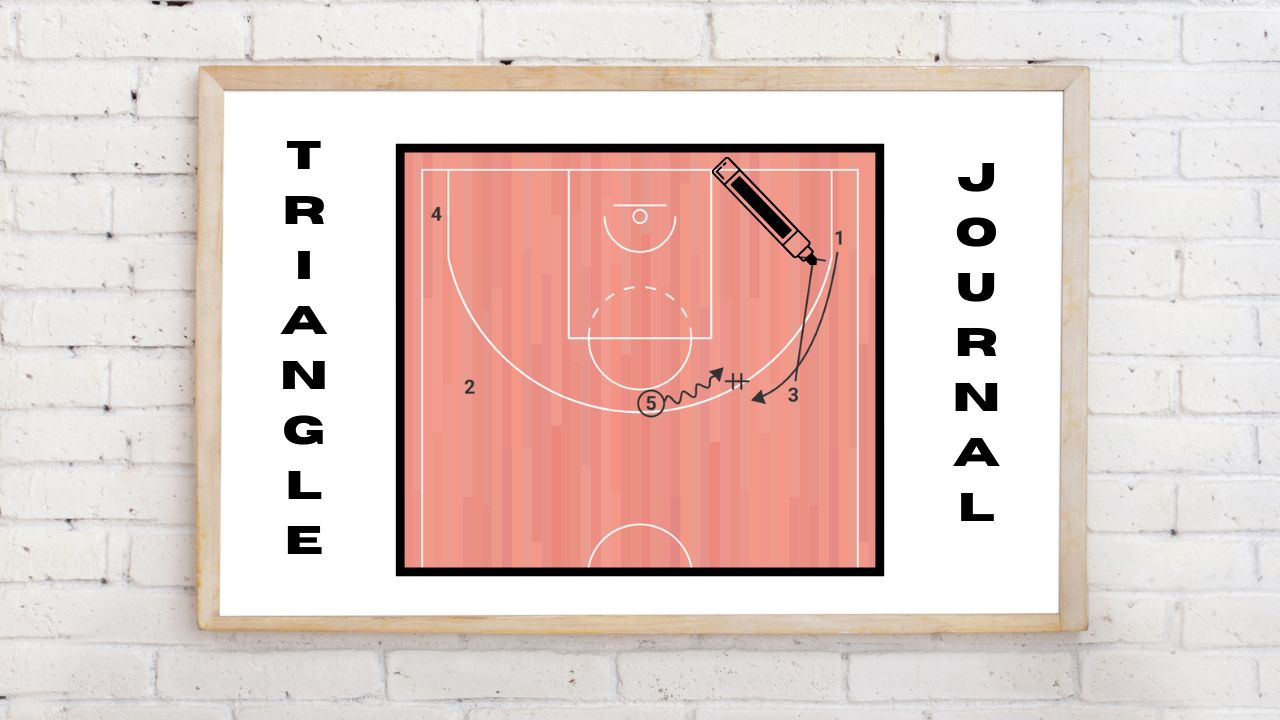
Zoom Action: The modern scoring trigger
In its simplest form, zoom action is a coordinated three-player sequence that begins with an off-ball screen followed immediately by a dribble hand-off (DHO). The screening player sets a down screen for a teammate (typically a wing) who curls toward the ball and receives the hand-off from the ball handler. That hand-off becomes both a pass and a screen, allowing the user to attack downhill hard while the original ball handler rolls, pops, or relocates.
This three-step sequence: screen → hand-off → read — is deceptively simple but creates multiple scoring options because it forces the defense to react instantly, often pulling multiple defenders toward one part of the floor and leaving space elsewhere.
Spacing & Timing: the engine of quality offense
Zoom action works not because of a crazy unique sequence to it, but because it orchestrates momentary convergence to breed wide spacing everywhere else:
- The off-ball screen bunches defenders momentarily, pulling help defenders into the strong side.
- The hand-off arrives when the screening angle and spacing are tight, which immediately isolates the receiver with room to attack.
- The three other players on the floor must maintain spacing — corners and weakside wings hold spots or float to spacing positions; creating gaps for drives, kickouts, and roll/pop opportunities.
Good timing here is everything: the hand-off shouldn’t come too early (defense slides too quickly) or too late (spacing collapses). When perfected, it forces the defense into indecision, defend the drive, rotate to the roller, or close out on nearby shooters; often too slowly, producing quality scoring opportunities.
Reads that generate quality shots
After the hand-off, the player receiving the ball has simplified reads:
• attack the rim downhill if the defender trails the hand-off.
• pull up or shoot a three if the defender goes under the screen or digs too early.
• kick to the roller (screener who drifts after screening) if help collapses.
• reverse to open shooters on the weak side if help erodes into the paint.
These reads aren’t just options, they’re natural answers to what the defense gives you. Because the action itself creates spacing and leverage, the offense is rewarded with high-quality shots, whether at rim, in pull-ups, or from deep.
Why zoom translates to any 5-out offense:
Zoom action won’t work without spacing, and that’s why it fits perfectly with 5-out principles: every player can be on the shell and threaten spacing, which keeps help defenders honest:
- In 5-out, players are positioned outside the three-point line so those help rotations have to travel farther, maximizing driving lanes.
- If the defense assists into the zoom action, the open space left behind by wings and corners becomes a kick-out opportunity for open threes or redrives, the heart of modern spacing offenses.
- Conversely, if defenders sag to protect the paint, the zoom receiver hits a close range look in rhythm.
This dynamic is why coaches across levels, from youth to college to NBA teams, run zoom actions inside motion frameworks rather than as isolated plays. The action teaches players to read defenders, move without hesitation, and attack with purpose, which are foundational skills for any offense.
Final Takeaway
Zoom action isn’t about memorizing a pattern, it’s about creating space through coordinated movement and then making the right decision. Its strength is that it simplifies reads, accentuates spacing, and forces defenses into uncomfortable choices, leading to quality scoring opportunities every time executed well.